Functional mushroom ingredient guide
Lion's Mane for Cognitive Performance: The Functional Mushroom Worth Understanding
Lion's Mane is the functional mushroom route for people interested in non-stimulant cognitive support, performance speed, and stress-related focus.
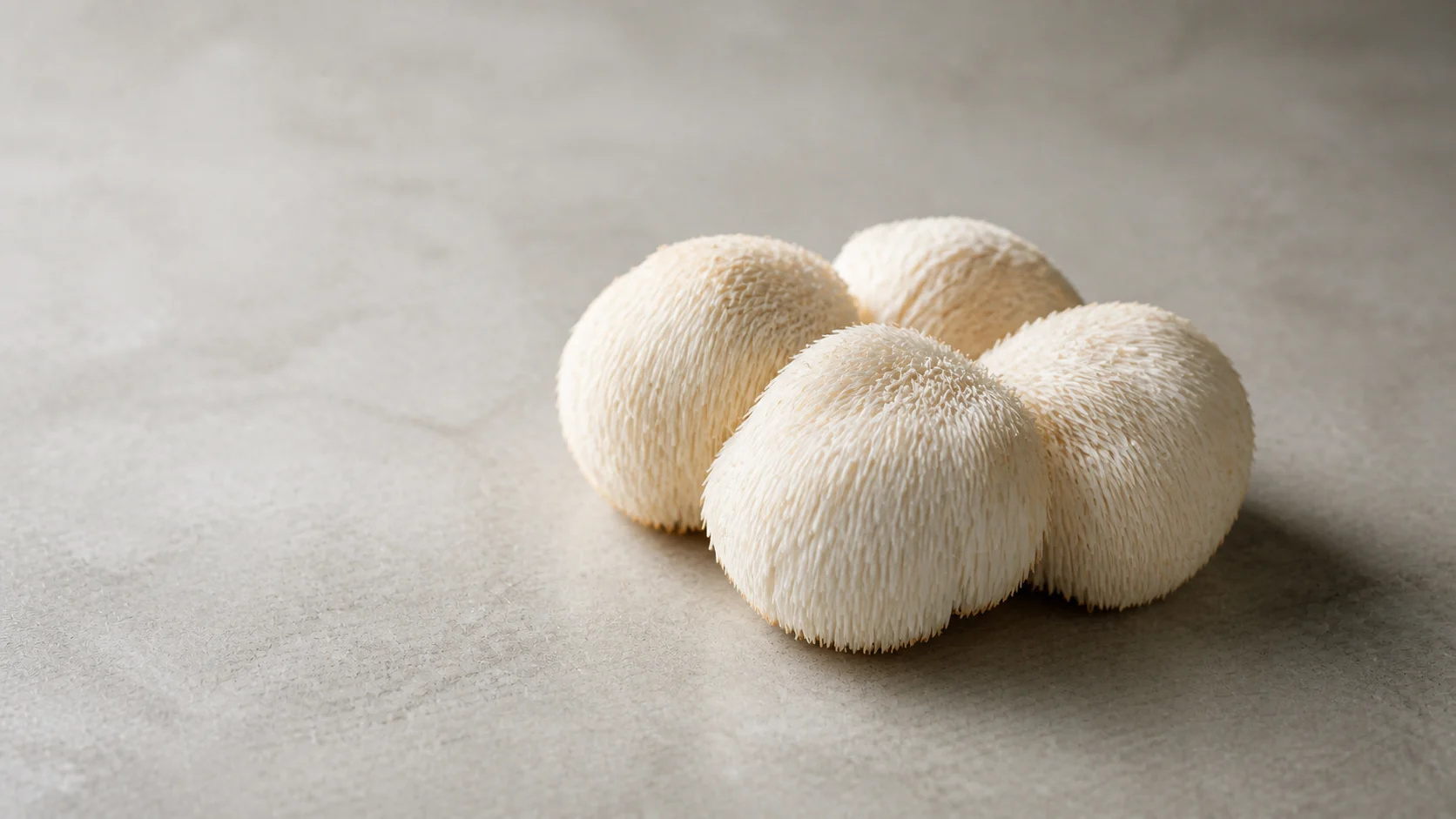
What Lion's Mane is
Lion's Mane is a functional mushroom known scientifically as Hericium erinaceus. It is one of the most popular mushroom supplements in the focus and nootropic space because it gives you a different route from caffeine, creatine, or choline-style ingredients.
It sits in the non-stimulant mushroom category, with a growing research story around cognitive performance, speed, and stress-related outcomes.
Lion's Mane earns a serious look because it has moved beyond generic brain mushroom marketing. It now has human research worth paying attention to, especially if you want a non-stimulant ingredient that feels more credible than vague mushroom-blend claims.
Why Lion's Mane gets attention for cognitive performance
Lion's Mane gets attention because it is one of the few mushroom ingredients with human research behind the cognitive-performance conversation.
A 2023 randomized, double-blind, placebo-controlled pilot study tested 1.8 g of Lion's Mane in healthy adults aged 18 to 45. After a single dose, participants were quicker on the Stroop task at 60 minutes. After 28 days, there was also a trend toward reduced subjective stress.
The authors concluded that the findings tentatively suggest Hericium erinaceus may improve speed of performance and reduce subjective stress in healthy young adults.
That is a stronger story than ordinary mushroom marketing. The useful takeaway: Lion's Mane is a non-stimulant mushroom ingredient with human evidence around speed of performance and stress-related outcomes.
What Lion's Mane may help with
Lion's Mane may be relevant if you want to compare non-stimulant ingredients connected to cognitive performance, stress, and longer-term brain-health interest.
Lion's Mane is worth comparing if you want a functional mushroom ingredient with human research around performance speed and subjective stress.
Lion's Mane is especially useful to compare carefully because labels vary a lot. Mushroom source, fruiting body vs mycelium, extract type, serving size, blend complexity, and label clarity all matter.
- Non-stimulant cognitive-support interest.
- Performance speed in attention-style tasks.
- Stress-related focus concerns.
- Functional mushroom product comparisons.
- A route that does not rely on more caffeine.
- Mushroom supplements before broad nootropic blends.
How quickly Lion's Mane may feel relevant
Lion's Mane is usually thought of as a longer-term mushroom supplement, but the 2023 pilot study makes the timing story more interesting.
In that study, participants performed faster on a Stroop task 60 minutes after a single 1.8 g dose. The 28-day portion showed a trend toward reduced subjective stress.
For product comparison, focus on the details that make Lion's Mane products easier or harder to evaluate: the mushroom source, form, serving size, whether the product is single-ingredient or a blend, and whether the label explains the ingredient clearly.
- Same-day research interest around speed of performance.
- Longer-term interest around stress and cognitive-support outcomes.
Who Lion's Mane may suit
Lion's Mane may suit people who want a non-stimulant mushroom route with a more interesting evidence story than ordinary wellness marketing.
The strongest positioning is simple: Lion's Mane is the functional mushroom route for people who want a non-stimulant ingredient with human research and a clear label-comparison challenge.
- Want to compare non-caffeine focus-support options.
- Are interested in functional mushrooms.
- Want human research rather than just marketing claims.
- Care about stress-related focus and mental performance.
- Prefer a non-stimulant route.
- Want to compare fruiting body, mycelium, extract, powder, and blend labels.
- Are choosing between Lion's Mane, Rhodiola, creatine, and caffeine-based options.
Lion's Mane vs caffeine, creatine, and Rhodiola
Lion's Mane is easier to understand when you compare it with nearby routes.
Caffeine is the fast alertness route. L-Theanine + Caffeine is the smoother-caffeine route. Creatine is the stronger evidence-backed non-stimulant performance route. Rhodiola is the lower-stimulation mental-fatigue route.
Lion's Mane is the functional mushroom route, with human research around speed of performance and stress-related outcomes.
A simple decision map: for fast alertness, start with caffeine timing; for smoother caffeine, compare L-Theanine + Caffeine; for stronger non-stimulant evidence, read Creatine; for mental fatigue, compare Rhodiola; for functional mushroom interest, Lion's Mane is worth understanding.
- Caffeine and Focus
Use this guide for timing, total intake, jitter, crash, and sleep tradeoff questions.
- L-Theanine + Caffeine
Compare the smoother-caffeine route if caffeine already helps but feels too sharp.
- Creatine for Mental Performance
Compare a stronger non-stimulant performance-support route.
- Rhodiola for Mental Fatigue
Compare the lower-stimulation mental-fatigue route.
Taking Lion's Mane safely
Lion's Mane is an edible mushroom, but supplement labels still deserve a careful look. Use extra care if you are allergic or sensitive to mushrooms, pregnant or breastfeeding, taking medication, managing a medical condition, dealing with bleeding or blood-sugar concerns, or planning surgery.
- Check the ingredient name Hericium erinaceus.
- Compare fruiting body, mycelium, extract, powder, and blend language.
- Review serving-size clarity, added caffeine or stimulants, warning-label transparency, and claims around brain health, focus, stress, or productivity.
For broader context, read the Focus Supplement Safety Guide.
Evidence and sources
Evidence note
Best supported for: speed of performance, subjective stress, and cognitive-support interest.
Evidence label: Early / limited
Lion's Mane has human research around speed of performance and subjective stress. A 2023 randomized, double-blind, placebo-controlled pilot study gives Lion's Mane a more credible story than ordinary mushroom marketing, while product labels and mushroom form still matter when comparing products.
Evidence can vary by ingredient form, study population, and outcome measured. Sources are listed below so readers can check the basis for our wording.
Source checked
Sources
Sources are included so readers can check the basis for our wording. We use sources to keep claims specific and cautious; sources do not mean an ingredient or product will have predictable results.
See Editorial Standards and Methodology for how sources are used.
- Safety / regulatory guidance
Official NIH-hosted background on Hericium erinaceus, human-evidence limits, reported short-term tolerability, and liver-safety context.
- Human study
PubMed-indexed 2023 randomized, double-blind, placebo-controlled pilot study in healthy adults aged 18 to 45. Included for the speed-of-performance and subjective-stress discussion.
- Human study
Small study in healthy college-age adults that did not find cognitive-performance effects, useful for balancing expectation-setting.
- Human study
Small acute study included as emerging evidence only; the page avoids turning it into a broad focus claim.
- Safety / regulatory guidance
Regulatory and safety background for supplement labels, premarket review limits, adverse reactions, and clinician discussion.
- Background reference
Plain-language safety overview used for general caution checks, including mushroom sensitivity and situations where professional advice is sensible.
Editorial process
Discernwell is written by Craig A. and source-checked against published research, supplement labels, and safety guidance where available. We do not claim medical review unless a qualified reviewer is named on the page.
Read the Editorial Standards and Methodology for more detail.